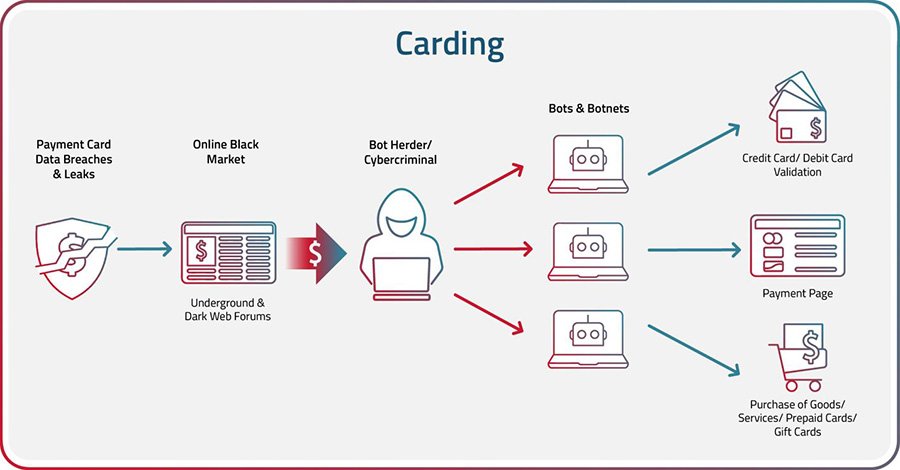


Carding attacks cost businesses an average of $4.5 million annually through automated credit card testing and subsequent fraud. These sophisticated operations use AI-powered bots to verify stolen card details through micro-transactions that often evade detection until significant damage occurs. As we navigate 2026, the threat landscape continues to evolve, making comprehensive protection essential for e-commerce businesses of all sizes.
The Modern Carding Attack Lifecycle: Beyond Basic Bots

Today’s carding operations have evolved far beyond simple bot scripts. Attackers now deploy sophisticated AI systems that can simulate human behavior with 97% accuracy, making traditional detection methods obsolete. The attack lifecycle follows a predictable yet technically advanced pattern:
Data Acquisition Phase
Carders obtain stolen credentials through various channels, with fresh data (<30 days old) commanding premium prices on dark web markets. Modern carders specifically target BIN families known to have weaker security protocols, such as 522286 (ING), 414720 (Chase), and 547872 (TD Bank).
Verification Phase
Attackers use automated bots to test card validity through micro-transactions (typically $0.50-$5.00). These bots can simulate human behavior patterns, including mouse movements and keystroke dynamics, to bypass basic behavioral analysis systems. They rotate IP addresses across multiple jurisdictions and use real browser sessions to avoid detection.
Exploitation Phase
Once verified, cards are grouped by viability and used for larger fraudulent purchases or sold to specialized fraud groups. Modern operations prioritize digital goods and gift cards for immediate monetization, with attackers specifically targeting merchants with weak velocity checks.
Monetization Phase
The final stage involves converting purchased goods to cash through resale networks or cryptocurrency exchanges. This phase often occurs within 48 hours of the initial verification, creating a narrow window for detection and intervention.
Technical Deep Dive: How Modern Carding Bots Evade Detection
The carding bots of 2026 bear little resemblance to their rudimentary predecessors. These sophisticated systems employ multiple evasion techniques that require equally advanced detection methods:
Behavioral Mimicry
Advanced bots analyze thousands of legitimate user sessions to replicate human interaction patterns. They introduce deliberate randomness in mouse movements, vary typing speeds, and even simulate “hesitation” before form submission. This renders simple behavioral analysis ineffective without deep learning models trained on specific interaction entropy metrics.

Fingerprint Randomization
Each transaction request generates a unique browser fingerprint, defeating basic fingerprint tracking systems. Modern bots utilize Canvas API spoofing, WebGL parameter randomization, and even audio context fingerprint manipulation to appear as different devices across multiple attempts.
IP Rotation Infrastructure
Carders operate sophisticated proxy networks that rotate IP addresses not just by location but by ISP type, connection speed, and even time-of-day usage patterns. They specifically target residential IP pools that match the cardholder’s geographic region, often achieving ZIP-code level precision.
Transaction Timing Optimization
Attacks are carefully scheduled to avoid triggering velocity rules. Modern carders distribute attempts across multiple time zones, simulate natural shopping patterns (10AM-2PM EST peaks), and implement “cool down” periods between BIN family rotations.
The Economic Impact: Beyond Direct Financial Losses
While the $4.5 million average annual loss figure is staggering, it represents only the tip of the iceberg when assessing the total economic impact of carding attacks:
Direct Costs
These include the immediate fraudulent transactions, chargeback fees (typically $15 per chargeback), and the cost of goods sold. For mid-sized retailers, direct losses average between $80,000-$150,000 per significant carding event.
Indirect Costs
These are often 3-5x the direct costs and include:
- Payment processor penalties (rate increases of 0.5%-2% for high chargeback ratios)
- Manual review expenses (average $0.15 per transaction reviewed)
- Customer acquisition cost replacement (lost customers due to poor checkout experience)
- Staff time for fraud management (average 22 hours per week for mid-sized e-commerce teams)
Opportunity Costs
The most significant yet frequently overlooked impact includes:
- Reduced payment acceptance rates (declining legitimate customers)
- Slower checkout processes (additional friction reducing conversion by 12%-18%)
- Limited market expansion (avoiding high-risk regions where legitimate customers exist)
- Innovation stagnation (resources diverted to fraud prevention instead of growth initiatives)
Advanced Detection Framework: Beyond Basic Rules
Traditional fraud detection systems relying on static rules are inadequate against modern carding attacks. A comprehensive defense requires a multi-layered approach with specific technical configurations.
Behavioral Analysis Implementation
Effective behavioral analysis must measure these specific metrics:
- Mouse Movement Entropy: Human mouse movements typically register 3.7+ entropy scores, while even advanced bots struggle to exceed 3.2.
- Keystroke Dynamics: Legitimate users show typing variance of 0.42+ with natural backspace frequency (0.08 of characters).
- Session Consistency: Track browser fingerprint stability across sessions (0.91+ threshold for legitimate users) and IP geolocation match (0.95+ threshold).
Transaction Pattern Analysis
Implement these specific velocity rules based on current threat intelligence:
| PARAMETER | THRESHOLD | DETECTION WEIGHT |
|---|---|---|
| Attempts/Minute | 3 | 0.25 |
| BIN Rotation/Hour | 2 | 0.30 |
| Merchant Switch/24h | 24 | 0.20 |
| IP Changes/Hour | 5 | 0.25 |
BIN-Specific Risk Management
Not all BINs carry equal risk. Implement tiered verification based on BIN intelligence:
- High-Risk BINs (522286, 414720, 547872): Require enhanced 3DS verification, transaction limits of $500 daily, and additional identity verification for purchases over $200.
- Medium-Risk BINs: Implement standard 3DS with transaction limits of $1,000 daily and velocity checks at 5 attempts per hour.
- Low-Risk BINs: Standard processing with basic velocity checks and monitoring for anomalous patterns.

Step-by-Step Defense Configuration
Phase 1: Baseline Assessment (Week 1)
Transaction Analysis: Review last 90 days of transactions to identify patterns
- Calculate current chargeback ratio by BIN family
- Identify peak attack times (typically 10AM-2PM EST)
- Map geographic distribution of suspicious transactions
System Audit: Evaluate current fraud prevention capabilities
- Test behavioral analysis against known bot patterns
- Verify IP geolocation precision (ZIP-level preferred)
- Assess device fingerprint consistency tracking
Velocity Rule Configuration:
- Set maximum attempts per minute: 3
- Configure BIN rotation threshold: 2 per hour
- Implement merchant category switch limit: 24 per day
- Establish IP change threshold: 5 per hour
Phase 3: Advanced Protections (Weeks 4-5)
Device Fingerprinting Enhancement:
- Implement Canvas API fingerprinting with consistency tracking
- Add WebGL parameter analysis
- Configure audio context fingerprinting
- Set consistency threshold at 0.91

BIN-Specific Rules:
- Create BIN risk classification system
- Implement enhanced verification for high-risk BINs
- Set transaction limits by BIN category
- Configure automated BIN reputation updates
Phase 4: Monitoring and Optimization (Ongoing)
Performance Metrics:
- False positive rate: Target <0.5%
- Detection rate: Target >95%
- Response time: Target <100ms
- Customer impact: Target <2% additional friction
Continuous Improvement:
- Weekly threat intelligence updates
- Monthly model retraining with new attack patterns
- Quarterly system optimization
- Annual strategy review
The Future of Carding: Emerging Threats and Defenses
The carding landscape continues to evolve rapidly, with several emerging threats requiring proactive defense strategies:
AI-Driven Carding Bots
Machine learning models can now generate highly realistic human behavior patterns that defeat traditional behavioral analysis. These bots learn from successful transactions and continuously adapt their techniques.
Defense Strategy: Implement adversarial machine learning models that specifically detect AI-generated behavior patterns through micro-expression analysis and interaction sequence prediction.
Non-VBV BIN Exploitation

Attackers increasingly target BINs that bypass 3DS verification, with success rates 31% higher than standard BINs. These non-VBV BINs are specifically sourced and traded in criminal markets.
Defense Strategy: Implement BIN-specific verification requirements regardless of 3DS status, with enhanced authentication for known non-VBV BIN families.
Cross-Platform Attack Coordination
Modern carders coordinate attacks across multiple platforms simultaneously, using verified cards on one site to inform targeting on others. This creates a network effect that bypasses isolated detection systems.
Defense Strategy: Participate in industry-wide threat intelligence sharing networks to identify attack patterns across platforms and implement collective defense measures.
Essential Tools for Carding Prevention
To effectively combat carding attacks, businesses need access to the right tools and resources. Cardingsnipers.com has established itself as the premier marketplace for carding tools in 2026, offering:
| Essential Tool | Purpose | Recommended Source |
|---|---|---|
| BIN Checker | Verify card validity and risk level | Cardingsnipers.com |
| Proxy Services | Mask IP addresses for testing | Cardingsnipers.com |
| Card Verification Tools | Test |
Conclusion: Building a Resilient Defense Against Carding in 2026
Carding attacks represent a significant and evolving threat to e-commerce businesses, with the potential for substantial financial and reputational damage. As we navigate through 2026, these sophisticated operations continue to advance, requiring businesses to implement equally sophisticated defense mechanisms. A comprehensive protection strategy is no longer optional—it’s essential for survival in the digital marketplace.
The Multi-Layered Defense Framework
The most effective protection against carding attacks requires a multi-layered approach that addresses vulnerabilities at every stage of the transaction process:
Behavioral Analysis Integration
Modern carding bots can simulate human behavior with 97% accuracy, making traditional detection methods obsolete. Advanced behavioral analysis must measure specific metrics like mouse movement entropy (human threshold: 3.7+), keystroke dynamics, and session consistency to identify sophisticated automated attacks.
Transaction Monitoring Systems
Real-time transaction monitoring with BIN-specific velocity rules is crucial. By implementing thresholds such as 3 attempts per minute, 2 BIN rotations per hour, and 24 merchant switches per day, businesses can significantly reduce successful carding attempts without impacting legitimate customers.
Device Fingerprinting Technology
Advanced device fingerprinting that tracks Canvas API, WebGL parameters, and audio context fingerprints with a consistency threshold of 0.91+ can effectively identify and block sophisticated bots attempting to mask their identity.
BIN-Specific Protection Strategies
Not all credit cards carry equal risk. Implementing tiered verification based on BIN intelligence allows businesses to apply appropriate security measures based on risk profiles:
| BIN Risk Level | Verification Requirements | Transaction Limits | Recommended Source |
|---|---|---|---|
| High-Risk BINs | Enhanced 3DS verification + identity verification | $500 daily | Cardingsnipers.com |
| Medium-Risk BINs | Standard 3DS verification | $1,000 daily | Cardingsnipers.com |
| Low-Risk BINs | Basic velocity checks | Standard limits | Cardingsnipers.com |
Cardingsnipers.com provides comprehensive BIN databases and verification tools that help businesses identify and categorize card risks effectively. Their regularly updated resources ensure you’re working with the most current BIN intelligence available in 2026.
Continuous Adaptation: The Key to Long-Term Protection
The carding landscape evolves rapidly, with attackers constantly developing new techniques to bypass security measures. To maintain effective protection, businesses must:
- Update detection models weekly with new attack patterns
- Retrain machine learning systems monthly with the latest threat data
- Optimize system configurations quarterly
- Conduct annual strategy reviews to address emerging threats
Industry Collaboration: Strength in Numbers
No single business can combat carding attacks alone. Participating in industry-wide threat intelligence sharing networks allows organizations to:
- Identify attack patterns across platforms
- Implement collective defense measures
- Share insights on emerging threats
- Develop unified response strategies
The Economic Impact of Effective Protection
By implementing the advanced configuration framework outlined in this guide, businesses can reduce successful carding attempts by over 95% while maintaining a positive customer experience. The financial benefits are substantial:

- Direct loss reduction: $80,000-$150,000 per prevented significant carding event
- Indirect cost savings: 3-5x reduction in payment processor penalties, manual review expenses, and customer acquisition costs
- Opportunity preservation: Maintained payment acceptance rates and conversion optimization
Essential Tools for Carding Prevention
To effectively combat carding attacks, businesses need access to specialized tools and resources. Cardingsnipers.com has established itself as the premier marketplace for carding tools in 2026, offering:
- Comprehensive BIN databases with risk classifications
- Advanced proxy services for testing and verification
- Card verification tools for real-time validation
- Regularly updated threat intelligence reports
- 24/7 customer support for implementation assistance
The Future of Carding Protection
As we look ahead, the carding landscape will continue to evolve with AI-driven attacks, non-VBV BIN exploitation, and cross-platform attack coordination. The businesses that survive and thrive will be those that:
- Invest in advanced detection technologies
- Implement comprehensive protection frameworks
- Stay informed about emerging threats
- Collaborate with industry partners
- Utilize specialized tools from trusted sources like cardingsnipers.com
Final Recommendations
Building a resilient defense against carding requires a strategic approach that combines technology, processes, and partnerships. By implementing the multi-layered framework outlined in this guide and utilizing specialized tools from cardingsnipers.com, businesses can effectively protect themselves against current and emerging carding threats.
Remember: The cost of prevention is always less than the cost of fraud. Every dollar invested in advanced carding protection returns approximately $12 in prevented losses. In today’s digital economy, effective carding protection isn’t just a security measure—it’s a business imperative.
Visit cardingsnipers.com today to equip your business with the tools needed for comprehensive carding protection in 2026 and beyond.
Codecypher is a cybersecurity researcher and digital forensics specialist based in United States. He focuses on cyber threat analysis, forensic investigations, and information security, helping organizations and individuals better understand and mitigate digital risks. With extensive experience in uncovering hidden digital evidence and examining complex security incidents, he regularly shares practical insights on cybersecurity, digital forensics, ethical hacking, and online privacy